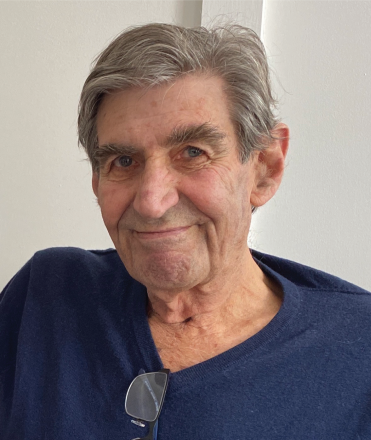
Professor Michael Drury Poole made major contributions to plastic surgery in the United Kingdom (UK), in Australia and internationally.
Born in 1942 in Manly, Sydney, Australia, Mike went to local schools but flourished more at university. He graduated from Sydney University in 1966 where he had topped the year in anatomy, completing a dissection of all the pelvic nerves including the autonomic nerves.
Mike trained in Sydney, Tasmania and New Zealand, obtaining the FRACS. He moved to the UK in 1971 to pursue plastic surgery, following the great Australasian tradition of working at Queen Victoria Hospital, East Grinstead. He was appointed as a plastic surgery registrar at The London Hospital in 1972 before returning to East Grinstead and then a post in head and neck surgery in Roswell Park, Buffalo, New York.
In 1976, he was appointed as a consultant at James Cook Hospital, Middlesborough. In 1978, he moved as consultant to the Radcliffe Infirmary, Oxford where, with neurosurgical colleague, Mike Briggs, he set up the Oxford Craniofacial Unit. The craniofacial centre soon became one of the three (at the time) recognised craniofacial centres in England and, from its early days, established a close and productive relationship with the genetics department in Oxford. This centre is one of his enduring legacies.
Mike was also involved, with a group of newly appointed consultants, in reacting against what they regarded as the complacency of the old guard, setting up an advanced course in plastic surgery. This course continues to thrive and is immensely valued. Mike was the host of the first meeting in Oxford in September 1981.
He married Margaret (Maggie) Serhan in 1966. Mike and Maggie had three children, Kingsley (1969), Sean (1971) and Christina (1983). A turning-point in Mike’s personal and professional life was the death in 1989, in a cycling accident in Australia, of their 17-year-old son Sean. Nothing was ever the same for Mike (and Maggie) after this tragedy.
Mike continued working in Oxford and was Editor of the British Journal of Plastic Surgery from 1991 to 1993.
In 1994, he moved back to Sydney where he became Professor of Plastic Surgery at the University of New South Wales, based initially at St George Hospital, Sydney where he also set up a head and neck cancer service, and later at The Children’s Hospital at Westmead where he created a craniofacial unit—the second establishment of such a unit in which he was instrumental. He was a very welcome visitor as a speaker and visiting professor to New Zealand and continued to be a trainer and mentor to young surgeons in Australia and New Zealand, as he had been in the UK. His longstanding friendship, support and mentorship were deeply appreciated by colleagues in Wellington, who were his contemporaries and formal fellows.
He returned to the UK as the Royal College of Surgeons of England McIndoe Lecturer in 1996 when he delivered the lecture on ‘Plastic Surgical Bridges’ at the British Association of Plastic Surgeons’ Meeting.
Mike was part of a period of rapid development in plastic surgery with the evolution of microsurgery and the development of craniofacial surgery, in both of which he was a pioneer. He was what has been described as a surgeon’s surgeon. Those who saw him operate were impressed by his speed, dexterity and efficiency. He made surgery look easy and effortless! Many of his trainees identified him as their surgical role model.
Despite his many accomplishments, Mike was always straightforward and unassuming. He had great integrity. His presentations at meetings were simple and without embellishments. For example, at a meeting of the Australasian College of Surgeons in Christchurch, New Zealand in 2007, he gave talks on ‘What I’ve learnt in head and neck surgery’ and ‘What I’ve learnt in craniofacial surgery’ without the selected pre- and postoperative photos of the era but with a description of the problems and complications he had encountered.
He was a sensitive and loyal man of few words, only speaking if there was something worth saying. He enjoyed a fine wine with friends and colleagues but did not indulge much in small talk. A walk with a friend in the countryside could take place without the need for conversation. He played an important part in the lives of many.
Mike retired in 2010 to pursue interests in sailing, painting and classical music (especially Mahler) with his partner, Megan Hassall, and her children. He died peacefully at home in Sydney on Friday, 12 December 2025.
He is survived by his ex-wife Maggie and their children—Kingsley, a GP and author in England and his three sons, and Christina, a solicitor in Australia and her daughter and son—and by Megan, his partner of 30 years and her three children, one of whom gave the eulogy at his funeral.
He is remembered with great warmth by many with whom he worked and whom he inspired in the UK, Australia and New Zealand. He will be greatly missed but his legacies in these countries remain.
We thank the many people who provided details that helped us write this obituary.
This article has been co-published in the Australasian Journal of Plastic Surgery and the Journal of Plastic, Reconstructive & Aesthetic Surgery. The articles are identical except for minor stylistic and spelling differences in keeping with each journal’s style.