In September 2026, the New Zealand Association of Plastic Surgeons/Te Kāhui Whakamōhou Kiri (NZAPS/TKWK) celebrated its fiftieth birthday. At its meeting in Wairakei in 1976, the newly formed association brought together what had previously been a series of independent plastic surgery units into a unified whole. The founding members—Patrick Beehan, Earle Brown, Colin Calcinai, Don Liggins, Max Lovie, William Manchester, Onkar Mehrotra, Thomas Milliken, John Williams and Keith Wilson—established a new constitution focused on professional standards, education, collaboration and peer review. William Manchester was elected as the first chair.1
In its creation, the society galvanised the collective voice of New Zealand plastic surgery and brought together surgeons into a new national forum that allowed collegiate, peer-reviewed education and an opportunity to discuss new ideas and techniques.
The NZAPS/TKWK has evolved into the peak plastic surgical body within Aotearoa New Zealand. It now oversees and monitors surgical standards, delivers the Medical Council of New Zealand/Te Kaunihera Rata o Aotearoa’s accredited training program in plastic surgery, provides a comprehensive, internationally recognised postgraduate education program, and advocates for sound health policy that protects the community of New Zealand. This work is provided pro bono.
New Zealand’s influence on the development of modern plastic surgery has been profound and extends back to its very inception as a modern specialty. Sir Harold Gillies, born in Dunedin, is widely regarded as the father of twentieth century plastic surgical technique. His innovations include the tubed pedicle, careful staged planning of surgical reconstruction with an emphasis on aesthetic outcome, and the integration of other surgical disciplines into plastic and reconstructive surgery, particularly prosthetics and dentistry. Gillies established the first plastic surgery unit at Queen Mary’s Hospital in Sidcup, Kent in 1916, and set about developing a team of surgeons to help him develop this new method of repairing wounds.2
In its infancy, New Zealand was instrumental to plastic surgery’s success. Sir Archibald McIndoe, Rainsford Mowlem and John Barron, all New Zealanders, collectively helped establish plastic surgery as a recognised surgical specialty.3 Their House surgeon, Benjamin Rank would later similarly lead the establishment of plastic surgery in Australia.4
The concept of a ‘society’ or a group of surgeons collaborating as a whole, is fundamental to the survival of surgery and underpins the profession.
Indeed, the name surgeon and the term ‘Mr’ originated in England from such a collaboration. In 1815, a group of highly trained hospital surgeons with a differing set of ethics and more specialised training, particularly in anatomy, distanced themselves from traditional barber surgeons and establishment physicians. They deliberately shunned the term Dr, preferring instead to call themselves Mr.5,6
In 1834, of the 8000 practitioners in England who held the title Member of the Royal College of Surgeons (MRCS), there were just 200 who called themselves Mr.7 Professional life for this group was difficult, as they deliberately abandoned the more lucrative parts of medicine, such as prescribing or midwifery, as well as the unscientific practice of bloodletting, to focus solely on surgery and surgical training. In time, as the community recognised their expertise, skill and training, they became known as the experts in surgical technique, with a higher ethical code focused on patient wellbeing rather than service provision.
In 1843, a new charter changed the Royal College of Surgeons of London into the Royal College of Surgeons of England. This new group of surgeons, or ‘pure surgeons’ as they were known, were provided for the first time with the title of ‘Fellow’ of the Royal College of Surgeons of England (FRCS).8 The title Fellow has continued into Australasia, where medical practitioners trained in surgery, and accompanied by a set of core competencies are awarded a Fellow of the Royal Australasian College of Surgeons (FRACS).
Collections of practitioners, merchants or tradespeople working together toward a common goal are not new and can be traced back as early as the twelfth century.9 Good historical examples include bakers, blacksmiths, leather workers and shoe makers, or more globally the oversight of the silk, fabric, pepper and spice trades.10,11 The livery companies in London12 and the Arte della Lana wool merchant’s guild in Florence13,14 are good examples.
While they cover a wide diversity of trades, these collectives, or guilds as they became known, all share common characteristics. They are almost exclusively urban. They are composed of well-defined hierarchies, from a master (or masters) at the top, to a group of travellers in the middle and the apprentices at the entry level. There is direct mentoring and training, with shared codes of conduct and practice.9,10
Broadly, guilds are divided into two groups: merchant guilds, focused on controlling trade, markets and commerce; and craft guilds, focused on skills training, standards and stopping low-quality imitations.9,10
In many ways surgical societies function as a craft guild. Surgical training is still treated as an apprenticeship, with direct mentoring and training in a predetermined set of skills. There is a shared moral code of conduct and practice, and the hierarchy of consultant to registrar to resident to intern and medical student is still present. And our craft guilds, the NZAPS/TKWK, Australian Society of Plastic Surgeons (ASPS) and Royal Australasian College of Surgeons (RACS), are designed to protect the quality and standards of surgical practice and procedures.
Like the pure surgeons of 1815, it is this commitment to standards, training, surgical competencies and the accompanying ethical framework, defining how we behave and work, that sets us apart and engenders respect and esteem within the community we serve.
But we should not be complacent, particularly in the age of social media, and we need to ensure this focus is accurately conveyed to both the community and government. It is important that they understand we are not merchant guilds: while their organisational structure was similar, the rationale for their existence and the intent of the organisation differed. Merchant guilds focused on trade, commerce and maximising profits. Trade routes, their protection and the logistics of delivering commodities, were the priority. And they became very good at it.
From the fifteenth to the early eighteenth centuries, merchant guilds developed spectacular political and societal influence. The Dutch East India Company dominated and ruthlessly controlled the supply of spices into Europe.15,16 The Hanseatic League controlled all shipping between the North Sea and the Baltic Sea and consequently trade across northern Europe.17 So much so, the King of Denmark took them to war, but then lost.
Not surprisingly, this influence elicited a tension between the merchant guilds and government. This is important and has relevance today.
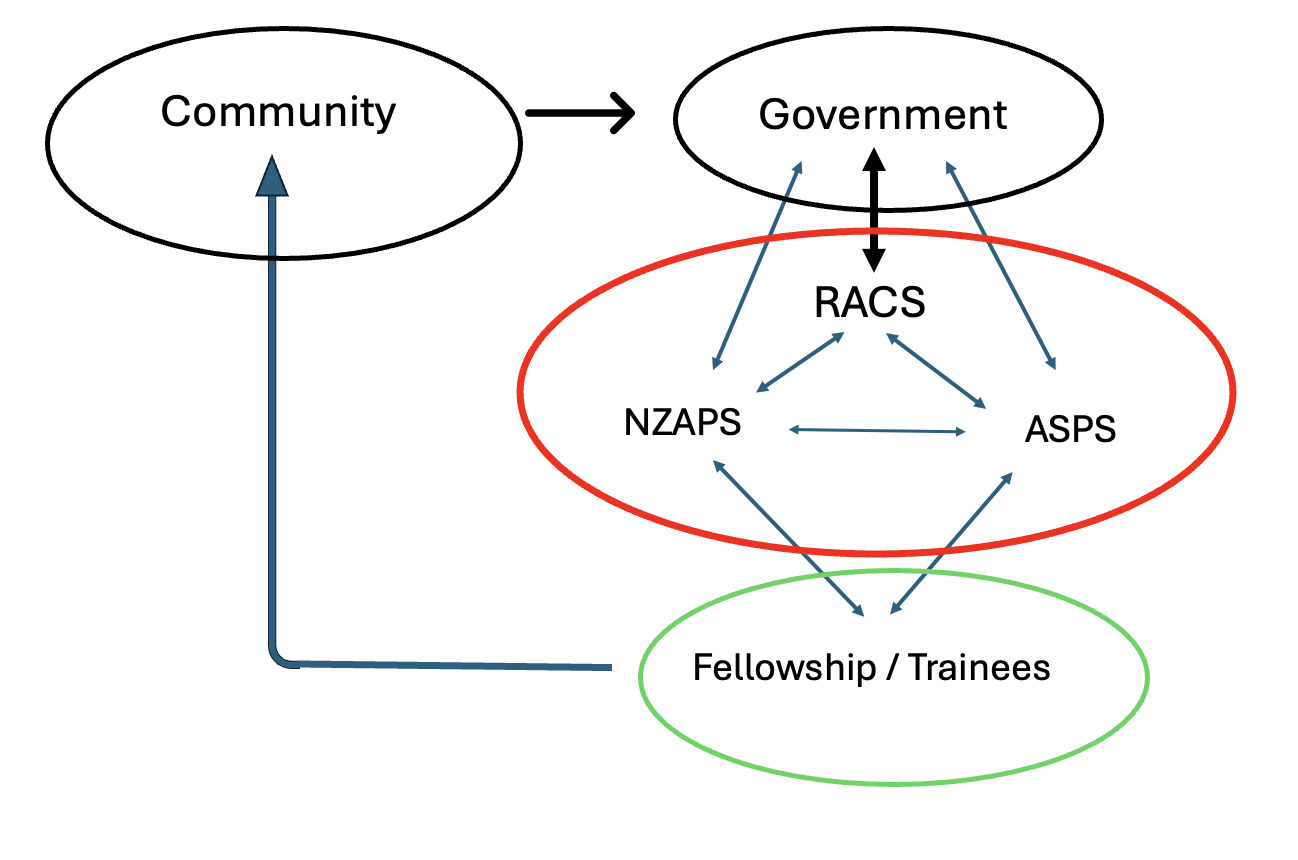
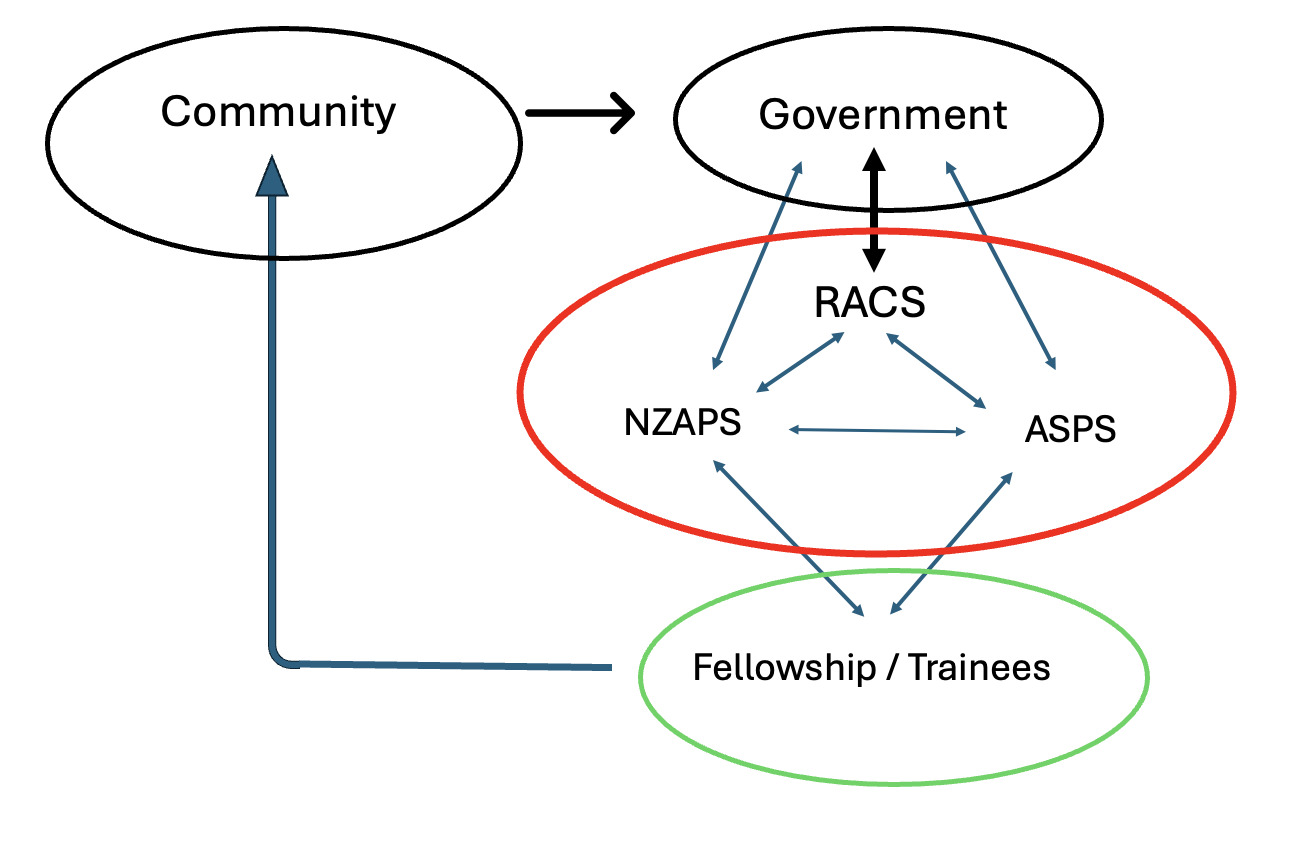
Our guilds (the NZAPS/TKWK, ASPS and RACS) are craft guilds, focused on training, education and providing a workforce of specialist surgeons to service the community. This is done on behalf of the government, who are entrusted by the community to provide them with appropriate specialist care.
When the community believes this contract is not being honoured, and they are not being provided with the level nor amount of specialist medical treatment they expect, they hold the government to account. Governments in turn renegotiate their contract with the specialist societies, to whom they have delegated this service delivery, and hold them accountable (Figure 1). The provision of medical care, particularly specialist medical care, to rural, regional and remote communities, is a strong example of this tension, and underpins the recent government re-evaluation of hospital training posts, specialist international medical graduate (SIMG) assessment, the expedited pathway to specialist accreditation and, more recently, the selection criteria into specialist training programs themselves.
But it is here that governments are misinterpreting and misunderstanding the nature of specialist medical colleges. They are not merchant guilds, focused on the protection of trade or turf. Nor are they focused on maintaining profits, but rather they more closely align with a craft guild, focused on the maintenance of standards and skills and protecting the community against the risks of inferior imitations.
More than ever our specialist societies must unite to develop sound policy and to more directly explain this difference. That as a society of aligned medical professionals, our intent is the maintenance of standards and the protection of the community we serve.
It is not a turf war.